

Detecting gold in the ground
In this article we explain a few concepts: How does a Metal Detector work? How can it detect gold in the ground? Can I build a simple detector myself? To build a more complicated device, first, you need to understand how a metal detector works, in order to make one.
Metal Detector Parts & Structure
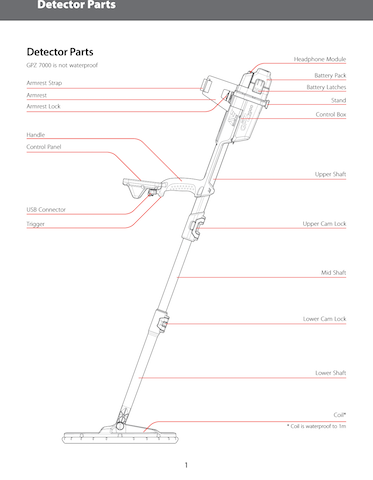
A regular metal detector is usually lightweight and it is made up of a few parts, such as:
- Control Box – this contains the circuits, batteries, controls, speaker and the microprocessor;
- Shaft – this connects the control box to the coil and you can more often than not adjust it comfortably for your height;
- Stabilizer (optional) – keeps the unit steady when you sweep it back and forth;
- Search Coil – Also known as the “loop”, “antenna” or “search head”, this is the part that actually senses the metal.
The basics of the workings of a metal detector are simple, when you turn on the unit, you slowly move it over the area you wish to search, and when you pass it over a target object, you get an audio signal. The more advanced detectors have displays that pinpoint the type of metal that you have detected and how deep underground the object is.
Once you understand the basics of metal detecting, you will have a deeper knowledge and understanding that you can use in order to build your own. First of all, metal detectors operate on the principle of magnetism, which means that a metal detector will set up a magnetic field through a coil of wire and then direct this field down into the ground.
Another circuit in the metal detector will listen to this field and emit a steady tone that you hear through a speaker. Once the coil has passed over the ground and a metal object is close to the magnetic field, this tone you hear will change pitch. When you hear this pitch change, this means you have found something and it’s time to start digging. The larger the coil of wire, the more sensitive the metal detector becomes.
What kind of detector is right for you?
You should also understand which type of metal detector might be right for you, as it should be tailored to the type of terrain that you intend to explore and what kind of treasures you are looking for.
These following technologies can be used within a metal detector, the very low frequency (VLF) which is able to track a variety of different metals over different terrains and it is the most used type; the pulse induction (PI), which is able to detect objects buried deep underground and filter out the presence of “black sand”, also known as magnetite, and it is popular amongst beachcombers and gold nugget prospectors; or the beat-frequency oscillation (BFO) which can detect any metal or mineral in range of its pulse, this is the most basic type. There is also the less used radio and calculator detector, which can detect close by metals, it’s not as fancy as the others, but it is very simple to assemble. The most commonly used is the VLF, so let’s get to know a little more about it:
VLF Technology
VLF, or Very Low Frequency, which is also known as induction balance, is the most popular detector technology used today. In a VLF metal detector, there are two distinct coils:
- The Transmitter Coil, which is the outer coil loop, with a coil of wire inside. Electricity is sent along this wire, in one direction then another, thousands of times every second. What establishes the frequency of the unit is the number of times that the current’s direction switches each second.
- Receiver Coil,which is the inner coil loop that has another coil of wire. This other wire works as an antenna and it picks up and amplifies frequencies coming from target objects in the ground.
Just like what happens in an electric motor, the current moving through the transmitter coil creates an electromagnetic field, and the polarity of it is perpendicular to the coil of wire. Whenever the current changes direction, the polarity of the magnetic field also changes, which means that if the coil of wire is parallel to the ground, the magnetic field is constantly pushing down into the ground and then pulling back out of it. When this magnetic field pushes back and forth into the ground, it interacts with conductive objects that it senses, which causes the objects to generate weak magnetic fields of their own. This is how the detector is able to find the object.
There are ways of building your own metal detectors using VLF technology or the other two kinds, but if you are just looking to build something quick and easy in your home, the simplest way to do it is with the radio and calculator detector, like Curious George.
Curious George makes a metal detector
For kids, building your very own metal detector can be both educational and fun and Curious George tells you how! Once you have seen the video you are ready!
Watch this 2 min video and see how it’s done, then follow my steps! https://youtu.be/1bsKIle7LjQ
Steps to Build your Metal Detector using a Calculator and Radio
- Get a calculator and a AM Radio, it’s that easy!
- Assemble the search head
- Tune the radio to the highest band on the AM setting
- Make sure you are not tuned to any station, and that you can hear the static tone quite clearly
- Turn on the calculator and position the two devices back-to-back until a steady and dull tone is emitted. At this stage, you might have to adjust the devices at certain angles or distances in order to achieve this specific tone
- Get some duct or electrical tape. Tape the devices in the position in which the tone has been found, and if the distance is too awkward to tape both of the devices together, then mount them in a position on a board.
- Place your search head on a shaft, a broomstick will do the job just right. Use duct tape in order to construct it easily and quickly.
- And that’s it! Now you just have to test your new, constructed metal detector on some household items, like a spoon, and if the detector starts to beep when you get closer to the spoon, then you’ve done it!
Watch this 2 min video and see how it’s done, then follow the steps! https://youtu.be/1bsKIle7LjQ
Now just go exploring with your new, home-made, metal detector!

Looking to buy rather than make a metal detector? Check out the fantastic detectors under $250 on Catch

